

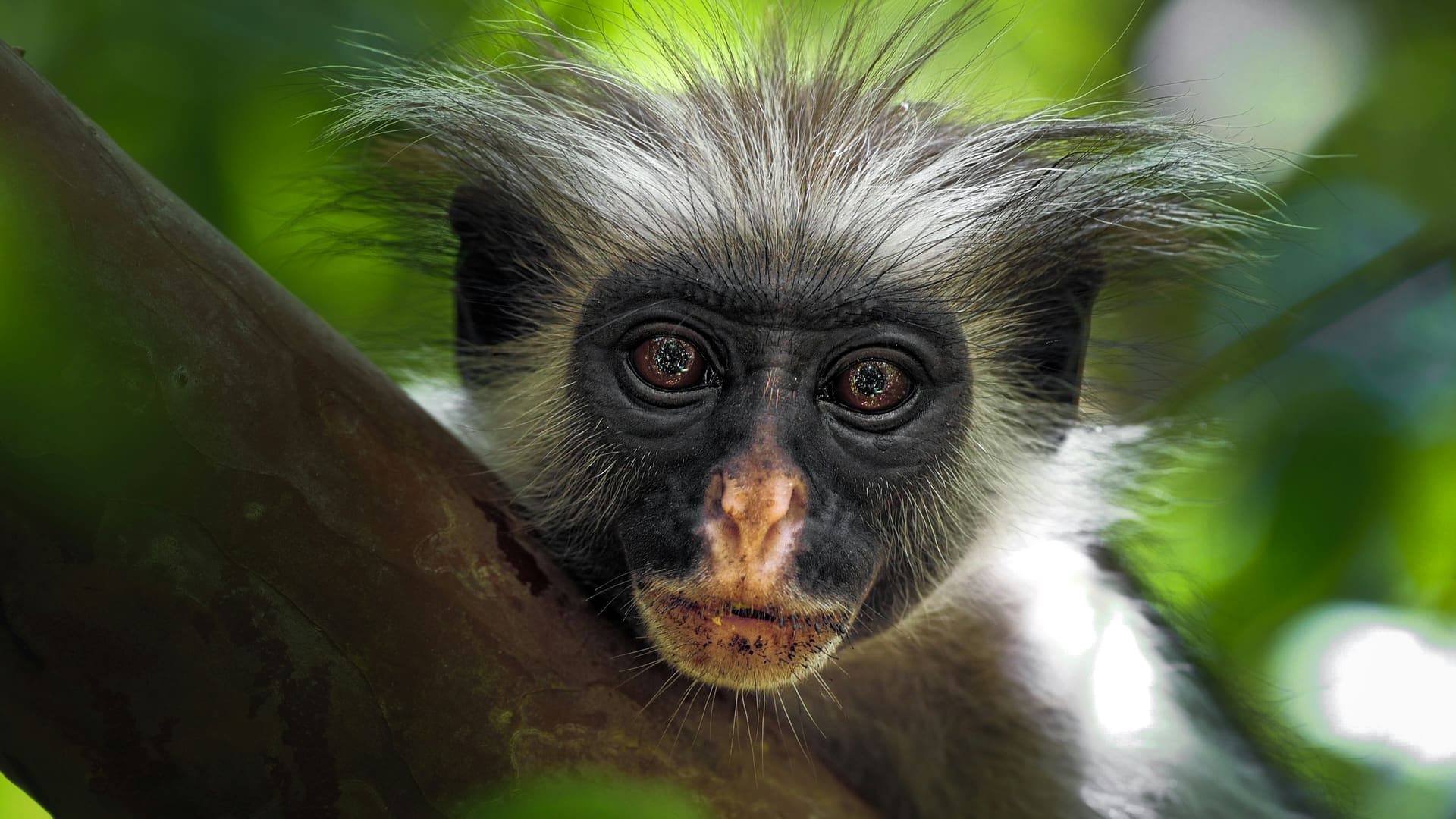
Jozani: The Last Refuge of Red Colobus Monkeys
In the Forest Where Monkeys Reign
It's 6 AM. Jozani Forest awakens in a symphony of bird calls and rustling leaves. Suddenly, a red flash crosses the canopy. A colobus. Then two. Then ten. They leap from branch to branch with disconcerting agility, their long tails serving as balancers. Welcome to the kingdom of East Africa's rarest primates.
A Monkey Like No Other
The Zanzibar red colobus (Piliocolobus kirkii) exists nowhere else on Earth. Endemic to the archipelago, it evolved in isolation for millennia, developing unique characteristics.
Its coat is a gradient of red, black and white. Its tail, longer than its body, can reach 90 cm. But what truly distinguishes it is its digestive system. Like cows, colobus have a multi-chambered stomach that allows them to digest leaves toxic to most other animals.
This adaptation allowed them to survive in an environment where food is scarce. But it also makes them vulnerable: they can only live in dense forests, rich in specific leaves. When the forest disappears, they disappear with it.
A Forest Under Pressure
Jozani-Chwaka Bay National Park is Zanzibar's only national park. Its 50 km² of tropical forest shelter 90% of the world's red colobus population. But this forest is an island in an ocean of agriculture.
In the 1960s, Jozani covered 200 km². Today, only a quarter remains. The rest was cleared to plant rice, spices, coconuts. Villages are closing in. Roads fragment the habitat. Colobus find themselves trapped in isolated forest pockets, unable to move.
The numbers are alarming. In 1995, there were 2,500 colobus. Today, there are 6,000. Good news? Not really. This increase hides a darker reality: the population is concentrated in an increasingly restricted space. Density is too high. Diseases spread. Inbreeding threatens genetic diversity.
Forest Guardians
Ali Makame has been a ranger at Jozani for 20 years. Every day, he patrols the forest, monitoring colobus, noting their movements, births, deaths. "I know every group, every individual", he says, pointing to a dominant male perched 15 meters high.
His work isn't limited to observation. He raises awareness among villagers, explains why trees shouldn't be cut, why colobus shouldn't be hunted (even though their meat is considered a delicacy by some).
The park employs 40 rangers like Ali. They're paid from tourism revenues: $10 per visitor. In 2023, 80,000 people visited Jozani, generating $800,000. This money finances salaries, anti-poaching patrols, reforestation programs.
The Future of Colobus
Saving red colobus means saving Jozani. And saving Jozani means convincing local communities that the forest is worth more standing than cut.
Several projects go in this direction. Ecological corridors are being created, linking Jozani to other forest fragments. Community nurseries produce indigenous trees to reforest degraded areas. Ecotourism programs allow villagers to benefit directly from conservation.
The model works. In Uzi, a neighboring village, residents created a private mangrove reserve where colobus live. They guide tourists, sell crafts, manage a restaurant. Result: income has tripled, and no one cuts trees anymore.
Visiting Jozani isn't just about seeing cute monkeys. It's understanding the fragile balance between man and nature. It's realizing that every dollar spent on tourism can save a species. Or condemn it, if that tourism is poorly managed. At Noor Experience, we've made the choice of responsibility: small groups, trained guides, respect for animals.